Household appliances
Drying cabinet for a communal laundry room: apartment buildings, sports clubs and schools
Koen van Viegen ·
A laundry room shared by dozens of people needs a dryer that keeps going every day. Why a drying cabinet works better there than a tumble dryer, which model suits which situation and what a cycle costs.
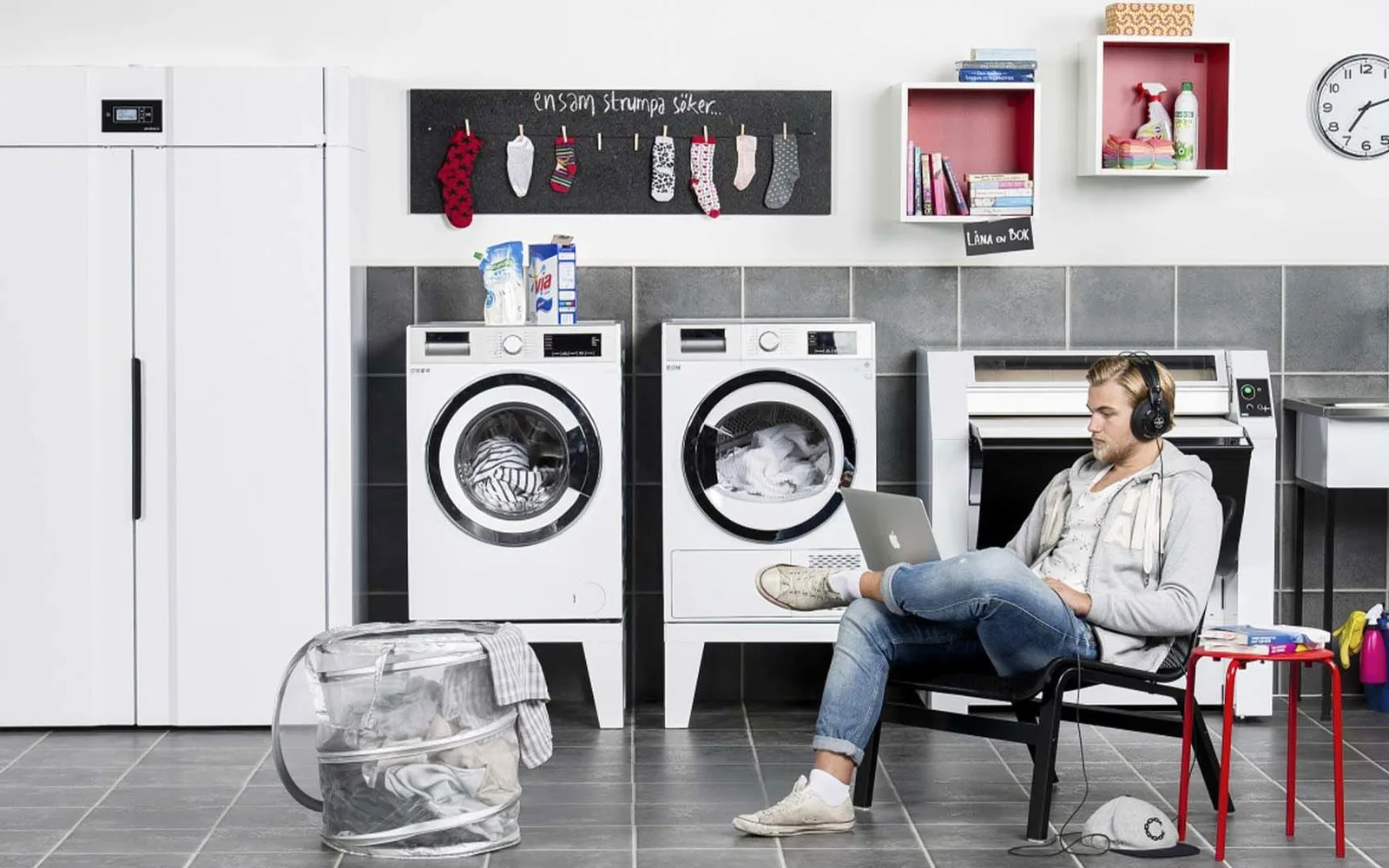
A communal laundry room runs on trust. Residents book a time slot, the sports club wants the kits dry on Saturday evening, and at school the rain suits need to be ready to wear again before the end of the day. If the dryer lets you down, everyone gets stuck. A drying cabinet works better there than a tumble dryer, and with the right choice and layout it runs for years without any hassle.
Why a drying cabinet works better than a tumble dryer
A tumble dryer with a drum is made for a single household. In a laundry room for a whole building or club it runs far more often, and then the drum, bearings and belt wear out fast. A drying cabinet has no moving drum. The washing hangs still in the cabinet and warm air does the work.
- No wear on a drum: nothing turns, so less can break. NIMO tests the Solano and Mistral for more than 30,000 drying cycles.
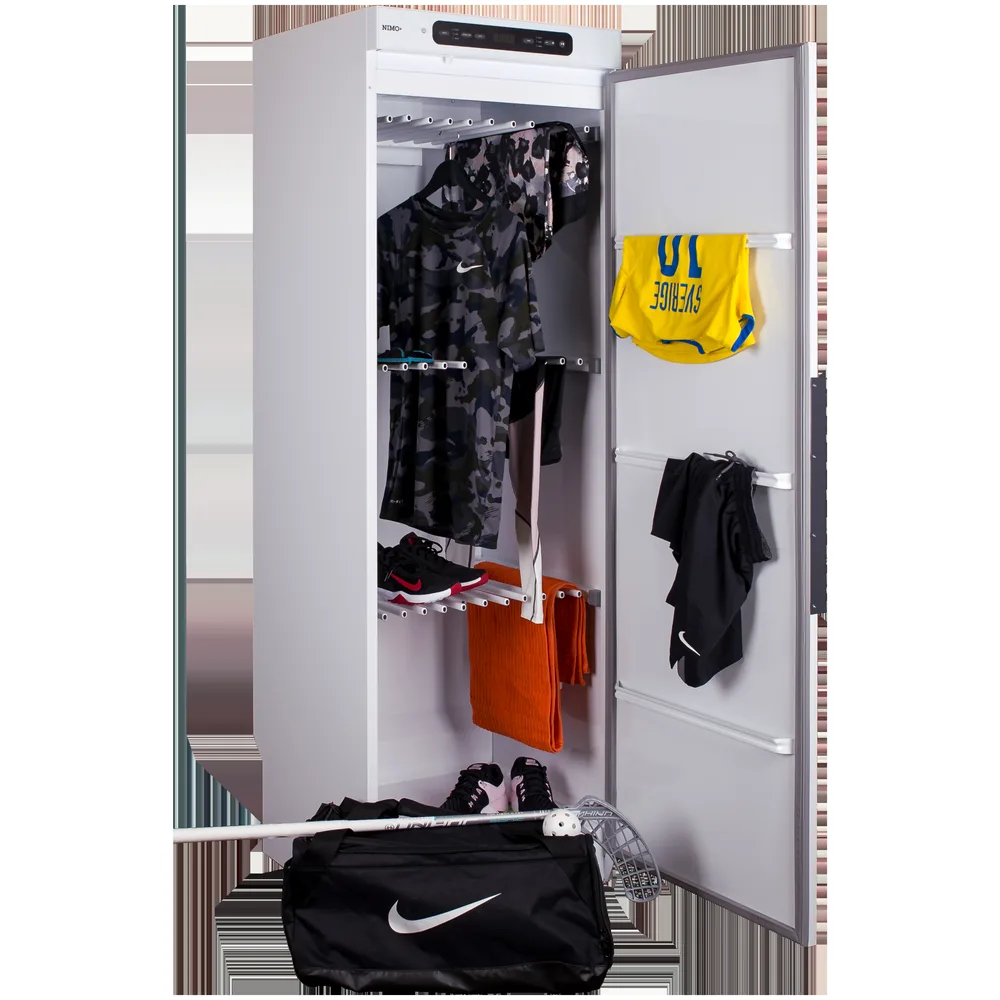
- Washing from lots of people: coats, sportswear, wool jumpers, shoes and gloves can all go in, without shrinking or bobbling.
- Hygiene: in Sweden, the research institute RISE showed that normal use of a drying cabinet, at 55 degrees or more and a drying time of more than 100 minutes, inactivates the coronavirus and norovirus.
- Low cost per cycle: with a heat pump or sensor you only use the energy that is needed.
- Predictable: the washing is dry within the booked time slot, so the next user can start on time.
Which model suits which situation?
The NIMO Passad 120 is the cabinet we recommend most often for shared laundry rooms. It works with a heat pump in a closed system, so you do not need a vent to the outside. It dries up to 24 kg, about 19 metres of washing line, behind double doors. At 48 dB it is quiet, and it runs on 230 V with a 10 A circuit. The water goes through a hose to the drain.
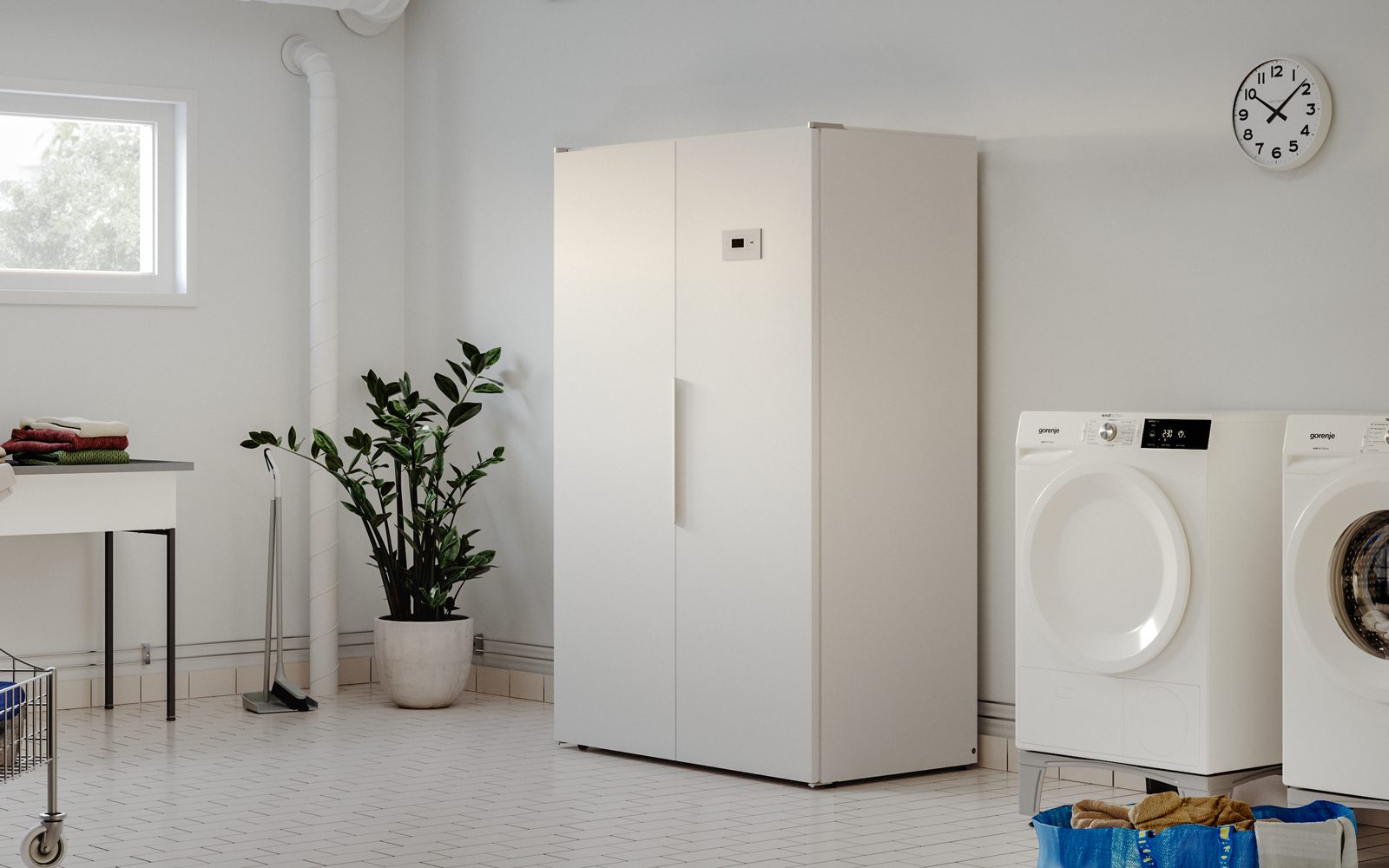
If the room already has a vent, the Solano DC 120 is a good choice. It extracts the humid air at 250 m³ per hour, has a moisture sensor that switches the cabinet off as soon as the washing is dry, 20 swing-out hangers and lighting inside the cabinet. It is the sensor that makes the difference in a room where nobody stays next to the cabinet.
For smaller spaces, such as a canteen, a changing room or the laundry room of a small owners' association, choose the Passad 60 or the Solano DC 60. The Passad 60 is plug and play, dries up to 11 kg and is even quieter at 45 dB. The Solano DC 60 has a sensor, 6 automatic programmes and an air extraction of 95 m³ per hour.
If you dry turnout gear or heavy workwear, the Zephyr WW Cabinet 120 is made for the job. It dries 4 sets of turnout gear, or 20 kg in 135 minutes, and runs on 3N 400 V. Read more in our guide to drying cabinets for fire services and workwear.
| Model | Technology | Capacity | Connection | Suits |
|---|---|---|---|---|
| Passad 120 | Heat pump, no vent to the outside | Up to 24 kg, 48 dB | 230 V, 10 A, hose to the drain | Owners' association, housing association, campsite |
| Solano DC 120 | Sensor, air extraction 250 m³/h | 24 kg, 20 hangers, 57 dB | Vent to the outside | Sports club, school, business |
| Passad 60 | Heat pump, plug and play | Up to 11 kg, 45 dB | Plug socket | Small laundry room, canteen |
| Solano DC 60 | Sensor, air extraction 95 m³/h | 6 automatic programmes | Vent to the outside | Nursery, changing room |
| Zephyr WW 120 | Vented, for workwear | 4 sets of turnout gear, 20 kg in 135 min | 3N 400 V | Fire service, workshop |
What a shared drying cabinet costs per cycle
In a shared laundry room every cycle counts, because the cabinet runs all day. At an electricity price of €0.30 per kWh, this is what you get:
- Passad 120, 6 kg in 60 minutes: 1.38 kWh, about €0.41.
- Passad 120, full 24 kg cabinet in 240 minutes: 5.52 kWh, about €1.66.
- Solano DC 120, 6 kg in 55 minutes: 4.2 kWh (0.7 kWh per kilo), about €1.26.
- Passad 60, full 11 kg cabinet: 2.31 kWh, about €0.69.
So the heat pump is the most efficient per kilo. The Solano DC 120 is slightly faster at 55 minutes for 6 kg. With dozens of cycles a week, the difference in energy use adds up quickly.
How Sweden saves on the laundry room
In Sweden the communal laundry room is completely normal, and the savings have been worked out carefully. SBC, the Swedish knowledge centre for housing cooperatives, ran the numbers for a laundry room with 350 drying cycles a week. A ten-year-old dryer uses 2.56 kWh per cycle on average, the NIMO Eco Dryer (now the Passad 60) 1.3 kWh. At SEK 2 per kWh, the saving in that example comes to SEK 44,100 a year.
Measurement company Intab sees the same picture. In an average apartment building about 15% of total energy use goes to the laundry room, and the dryers account for about 70% of that. If the machines are more than ten years old, modern technology saves you 50% on energy use.
The municipality of Karlstad has about 250 drying cabinets in its nurseries and primary schools and is replacing them with the NIMO Sensor Dryer 1900, today's Solano DC 60. That cabinet stops as soon as the clothes are dry and uses about half the energy of a traditional drying cabinet with a timer. In Gothenburg, the biggest loss turned out to be cabinets with a broken timer that kept running all night. A sensor prevents that.
Tips for laying out the laundry room
- Ventilation or connection: decide beforehand between a heat pump without a vent to the outside and a vented cabinet. You can read more about the first in our article on the heat pump drying cabinet without a vent.
- Floor drain: the Passad 120 drains the water through a hose, so make sure there is a drain nearby. A floor that slopes towards the drain is a smart idea in a laundry room anyway.
- Wall fixing: every cabinet must be fixed to the wall. With a full load of wet washing and lots of users, stability is not a detail.
- Space: measure carefully, including the swing of the doors. The Passad 120 has double doors, so keep enough free space in front of the cabinet.
- Electrical circuit: a Passad 120 or Passad 60 runs on 230 V with a 10 A circuit. Put several cabinets on separate circuits, and allow for 3N 400 V for the Zephyr.
Advice and quotes for business customers
XARO advises boards of owners' associations, housing associations, sports clubs, schools, nurseries, campsites and businesses. Tell us how many people use the laundry room, what gets dried and which connections are available, and we will work out which model and how many cabinets you need. Every cabinet comes with a 3-year NIMO warranty, which you arrange through XARO. Would you like a quote? Just get in touch with us.
In a communal laundry room a drying cabinet is the most reliable choice: no drum to wear out, room for everyone's washing and a low cost per cycle. For most rooms the Passad 120 is the answer, with the Solano DC 120 when the vent is already in place. Want to look around first? Browse all NIMO drying cabinets.
Drying cabinets for shared laundry rooms
The Passad 120 and Passad 60 work without a vent to the outside. The Solano DC 120 extracts the air and stops by itself when the washing is dry.
Ask for advice or a quote - For owners' associations, housing associations, sports clubs, schools and businesses.
Frequently asked questions
- Which drying cabinet is best for a communal laundry room?
- For most shared laundry rooms the NIMO Passad 120 is the best choice. It dries up to 24 kg, needs no vent to the outside and runs on 230 V with a 10 A circuit. If there is already a vent, the Solano DC 120 with a sensor is a strong alternative.
- Why a drying cabinet rather than a tumble dryer in a laundry room used by many people?
- A drying cabinet has no rotating drum. So there is no drum or bearing to wear out, the washing hangs still and does not get damaged, and coats, sportswear and shoes can go in too. NIMO tests the Solano and Mistral for more than 30,000 drying cycles, so they are built for heavy daily use.
- What does a drying cycle cost in a shared drying cabinet?
- At €0.30 per kWh, 6 kg in the Passad 120 costs about €0.41 (1.38 kWh) and a full 24 kg cabinet about €1.66 (5.52 kWh). In the Solano DC 120, 6 kg costs about €1.26 (4.2 kWh).
- Does a drying cabinet have to be fixed to the wall?
- Yes. Every NIMO drying cabinet must be fixed to the wall. That keeps it stable even with a full load of wet washing, which matters even more in a room many people use.
- Does a drying cabinet help prevent infections at school or nursery?
- The Swedish research institute RISE studied this on behalf of NIMO. The study shows that normal use of a drying cabinet, at a temperature of 55 degrees or more and a drying time of more than 100 minutes, inactivates the coronavirus and norovirus.
- Can XARO advise on a business enquiry?
- Yes. XARO advises owners' associations, housing associations, sports clubs, schools and businesses on the right model and number of cabinets, and is happy to prepare a quote. Get in touch with us.