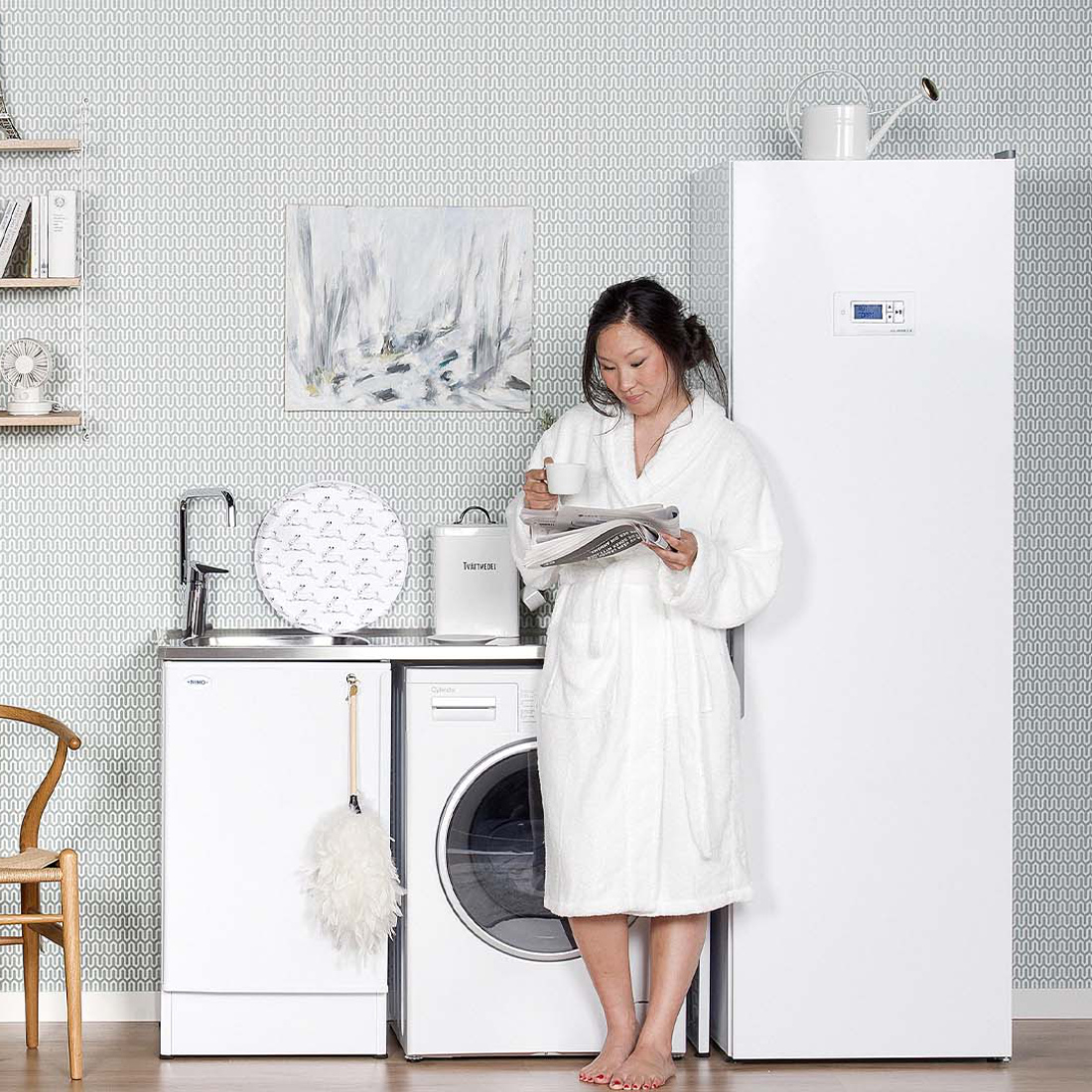
Anyone considering a drying cabinet for clothes soon runs into the same question: where does the humid air go? In a rented flat, an apartment or a utility room without an outside wall there is no vent, and drilling a hole in the wall is not always possible or allowed. The good news: you do not need one. A heat pump drying cabinet works without a vent to the outside. You put it in place, plug it in and start drying.
How does a ventless drying cabinet work?
In a drying cabinet your washing hangs still on rails or hangers, while the cabinet blows warm, dry air along the fabric. The moisture that evaporates from your clothes has to go somewhere. A vented drying cabinet blows that humid air outside through a hose. A heat pump drying cabinet works differently: it keeps the air inside the cabinet and takes the moisture out, just like a dehumidifier. The moisture becomes water, and the dry air passes over the washing again.
Because the air circulates in a closed loop, no duct is needed and no humid air enters the room where the cabinet stands. That also makes a heat pump drying cabinet suitable for places where an airer causes problems, such as a small flat or a storage room without a window.
Where does the water go?

In the NIMO Passad 60 the water collects in a removable 2 litre tank at the bottom of the cabinet. A float stops the cabinet automatically once the tank is full, so nothing ever overflows. You empty the tank into the sink, just as with a dehumidifier.
Would rather not empty it? Then connect a hose. The Passad 60 has a built-in pump that sends the water to a drain up to about 1.2 metres above the floor. If the cabinet stands next to the washing machine or a sink, you can usually use that drain and never think about it again.
What do you need to install it?
- A plug socket: 230 V on a 10 A circuit, power rating 1100 W. No special connection.
- A space 60 cm wide: the Passad 60 is 59.5 cm wide, 67.5 cm deep and 193 cm tall.
- Room for the door: the door is hinged on the right.
- Two people to put it in place: the cabinet weighs 95 kg.
- Optionally a drain: only if you do not want to empty the tank.
Where can you put a ventless drying cabinet?
Because you are not tied to an outside wall, you have far more choice than with a vented dryer. People put it in the utility room next to the washing machine, in a storage room or in a laundry room in the loft. At 45 dB it is a lot quieter than a tumble dryer, so even in a flat where the laundry room is close to the living room you will hardly hear it.
If you rent, that is the biggest win: you do not have to drill through the wall and you leave nothing behind when you move. The cabinet simply comes with you.
How much washing fits and how fast is it dry?
The Passad 60 dries up to 11 kg of dry laundry, about 16 metres of washing line. Inside there are three pull-out racks where you hang clothes directly or on hangers. For long coats or dresses you fold away the bottom two racks, so you can use half or the full height. Gloves and hats hang in the door, and boots and trainers dry on the shoe rack at the bottom.
According to NIMO, a half load of 5.5 kg is dry in about 2 hours and a full cabinet in about 4 hours. One button lets you choose between iron dry and cupboard dry, and the cabinet switches itself off when the washing is dry. The temperature inside stays below 55 °C, so shirts and delicate fabrics can go in too.
What does a load cost?
A heat pump reuses the heat instead of blowing it outside, which makes it efficient. The Passad 60 uses 0.21 kWh per kilo of washing. A full cabinet takes 2.31 kWh, so at €0.30 per kWh about 70 cents. According to NIMO that is up to 65% less than a vented drying cabinet.
| Heat pump drying cabinet | Vented drying cabinet | |
|---|---|---|
| Vent to the outside | Not needed | Hose through wall or window |
| Water | Tank or hose to the drain | Leaves as vapour outside |
| Energy use | Low, according to NIMO up to 65% less | Higher |
| Location | Anywhere with a socket | By an outside wall or existing vent |
| Purchase price | Higher | Lower |
Which ventless drying cabinet should you choose?
For most households the NIMO Passad 60 is the obvious choice: slim, quiet and truly plug and play. It comes in white and in a black version. If you have a large family or dry a lot of workwear, the Passad 120 is an option. It dries more than twice as much behind double doors and drains the water through a hose, so you need a drain nearby.
Already have a vent in your laundry room, for example from an old tumble dryer? Then a vented drying cabinet is an affordable choice. Want to know more about what a drying cabinet is, or why clothes will not dry indoors in winter? Our guides explain it.
Drying cabinets without a vent
Heat pump, closed system. The Passad 60 works with a tank or hose, the Passad 120 with a hose to the drain.
View the heat pump drying cabinets - No vent needed. Free delivery in the Benelux, €60 to Germany.
A heat pump drying cabinet is the easiest way to dry indoors without moisture in your home. No hole in the wall, no hose out of the window, just a socket and a space 60 cm wide. Not sure whether it fits your utility room or storage room? Feel free to get in touch. You can also compare all drying cabinets and the heat pump drying cabinets.